
Industry News

The May event is open to AABP members. AABP Executive Director Dr. Fred Gingrich will host the event, which also features Dr. Brandon Treichler and Dr. Justine Britten.

The first few hours of a calf’s life are critical to its success. Sometimes when producers need to intervene, the new mom goes into protection mode.

President Trump has announced a series of tariffs, scheduled to roll out over the next few days, on some of agriculture’s most significant trade partners. The outcomes could be a net positive for cattlemen, some beef industry members say.

With heifer prices at record highs, raising replacements on-farm can be a money saver since 2024 costs are much lower than buying on the market.

Keep unwanted visitors out by buttoning up your biosecurity measures to prevent the introduction and spread of infectious diseases and pathogens.
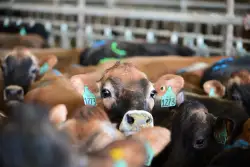
The U.S. dairy industry, driven by substantial investments and shifting consumer preferences, is poised for significant growth in the coming years.

The March Ag Economists’ Monthly Monitor asked economists if they think the U.S. general economy will see a recession in 2025. 62% said yes.

When a virus moves into a new geographical range or is reintroduced into a country that has maintained a negative status for a long period, SHIC’s Megan Niederwerder says it’s critical to reassess the risk to the U.S.

H5N1 is different than other new swine disease outbreaks because USDA has jurisdiction over H5 in any animal, so they have the regulatory authority, says Scanlon Daniels, DVM.

USDA Secretary Brooke Rollins says the agency is hyper-focused on poultry, but no vaccine is yet available. The agency has ‘separate work streams’ to address the virus in the ‘cattle and dairy’ industries, but dairy is not part of USDA’s primary focus for now.

Soon after the discovery of highly pathogenic avian influenza (HPAI) strain H5N1 in dairy cattle, scientists learned that milk was a primary vector in spreading the disease from cow to cow.

The U.S. bovine semen industry’s resurgence in 2024 signifies more than just a recovery. It represents a transformative wave of growth that is poised to impact livestock reproduction on a global scale.

Researchers are using gene editing techniques to introduce beneficial traits like polled and disease resistance, as well as exploring innovative approaches like surrogate sires.

Calculate a bull’s value proposition and consider how he can meet a herd’s needs and goals before purchasing.

Changes in BCS at dry-off and parturition have been associated with differences in health, performance, and survival.

When cows accumulate too much copper, it piles up in the liver. The result can be liver damage at the cellular level, liver necrosis, and impaired liver function.

Last week, the U.S. dollar had the worst week-to-week performance since 1995 and that, combined with global dairy price premiums, should spark some export interest and support domestic prices.

Specific lots may contain elevated or deficient levels of nutrients which may be harmful to cattle, the company says.

The total U.S. feedlot inventory on Jan. 1, 2025 was 14.297 million head, including 2.474 million head in feedlots with capacity less than 1,000 head.


Much of the West, Southwest and upper Midwest could use more moisture. Beef and dairy producers and their veterinarians might want to do some contingency planning for what’s shaping up to be a dry spring.

Hans Coetzee’s work has been instrumental in clearing the way for the first regulatory approval of livestock analgesics, or pain relief medicine, that have eased the pain of millions of animals.

USDA’s latest Cattle Inventory report showed U.S. beef cattle numbers fell to the lowest level in 64 years to start the year. Tight supplies and strong demand could push cattle prices to even higher highs in 2025, but uncertainty is infusing more risk and volatility into the markets.

Denton will help guide content development for the beef cattle audience and provide solutions to enhance animal production, management best practices and profitability.

Last year’s USDA Cattle Inventory Report showed the smallest cattle herd since 1951. With strong heifer prices and no strong signs of rebuilding underway, the Ag Economists’ Monthly Monitor shows supplies may come in even lower than last year.

Toothless guidelines, inadequate testing and long delays in releasing data -- echoes of the missteps during the Covid-19 pandemic -- have squandered opportunities for containing the outbreak.

With food recalls skyrocketing, one might find it hard to discern whether they’re reading a current USDA Food Safety and Inspection Service report or a chapter straight out of Upton Sinclair’s 1906 novel “The Jungle.”

Sec. Mike Naig says the U.S. government is using what he describes as a three-legged stool approach to address the virus in the dairy and poultry industries.

As the nation grapples with immigration policy debates, the livelihoods of those within the dairy sector hang in balance, underscoring the urgent need for balanced reform that considers both economic imperatives and humanitarian values.

Trump agenda | Delay in China tariffs | Dollar tumbles | Biden issues family pardons | Vilsack criticizes EPA report on biofuels | Putin open to dialogue on Ukraine with Trump | Buller chief of staff at USDA