
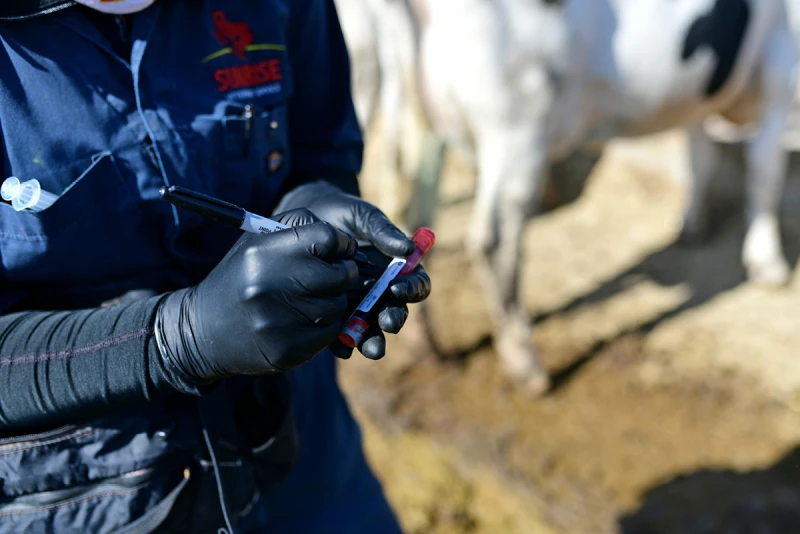
When cattle are dying unexpectedly, it can be tempting to start collecting whatever samples are easiest to obtain. Dr. Scott Fritz says the best approach is to start with a guiding question.
Fritz, a veterinary toxicologist and assistant professor at Kansas State University and section head of toxicology for the Kansas Veterinary Diagnostic Laboratory, shared a practical framework for investigating suspected toxic exposures during the 2026 AABP Annual Conference. His advice centers on a simple principle: the diagnostic question should drive the samples.
Start With the Case, Not the Sample
Before collecting anything, go back to basic case investigation.
Fritz recommends establishing:
- What is happening clinically?
- Which animals are affected?
- How many animals are affected?
- Are certain age or production groups more affected?
- What changed recently?
- When did the problem begin?
- What is the timeline relative to the suspected exposure?
The timeline is particularly important in acute death-loss investigations because toxicants move through the body over time.
“It’s really basic case investigation and that information is important for the diagnostic lab,” Fritz says.
That information helps narrow the differential. In a suspected toxicology case, the differential should not automatically consist only of toxicants. Infectious and other causes of the clinical presentation should remain on the list until the case investigation provides evidence to narrow it.
Let the Suspected Exposure Guide the Samples
Once the clinical picture and differential are established, think about where the suspected toxicant could be in the animal. Fritz recommends using the biology of absorption, distribution, metabolism and excretion as a framework rather than relying on a single standard set of samples.
For many suspected ingestions, the basic toxicology sample set includes:
Rumen or gastrointestinal contents: This can provide evidence of what the animal consumed and is particularly useful when ingestion is suspected.
Blood or a postmortem proxy: When blood is unavailable, ocular fluid and urine can provide useful information.
Liver: Many compounds are metabolized in the liver, making it an important sample for toxicology testing.
Kidney or urine: These can be useful because many compounds or metabolites are eliminated through the urinary system.
From there, let the clinical presentation expand the sample list. Neurologic signs may warrant brain tissue. Musculoskeletal signs may warrant muscle. Fat or bone can be useful when a compound is known to concentrate in those tissues.
The point is that there is no cookie-cutter toxicology submission. That is why calling the laboratory before sampling can be more useful than trying to memorize every possible toxicant and its distribution pattern.
Don’t Forget the Source
The animal is only part of the investigation.
When ingestion is suspected, collect representative samples of potential sources, including feed, ration components or water when appropriate.
This is where representative sampling becomes critical.

Fritz uses a haystack as an example. If a herd has consumed hay from a large group of bales, a single sample taken from one location may be analyzed very accurately by the laboratory. The problem is that an accurate result for the submitted material does not necessarily tell you whether that material represents what the cattle actually consumed.
The same principle applies to other feed and environmental samples. A laboratory can only analyze what arrives in the bag.
Timing Can Change the Investigation
Toxicology results also have to be interpreted in the context of when exposure occurred.
“The timing relative to when they ate it will tell you where it’s at in the system,” Fritz says. “And it’s different for all the different compounds.”
A compound may move from the gastrointestinal tract into circulation, into tissues and eventually through metabolic and excretory pathways. Where it can be detected may therefore change over time.
That makes the timeline collected during the initial case investigation especially important. If the timing of exposure is uncertain, that is another reason to consult the diagnostic laboratory before deciding what to collect.
Send Enough Sample to Keep Your Options Open
Another common mistake is collecting only enough material to answer the first hypothesis.
Fritz recommends sending enough sample to allow for additional testing if the initial hypothesis proves incorrect. That gives the laboratory room to pursue a different differential if new information changes the direction of the investigation.
Samples also need to be handled appropriately. Refrigerate them as needed and protect them from contamination, particularly when pesticides or other environmental contaminants are suspected.
Sample identification is another basic step that can have significant consequences.
Fritz recommends associating samples with the individual animal or source from which they came. In cases that eventually become subject to legal scrutiny, failure to maintain that identity can undermine an otherwise useful investigation.
Give the Laboratory the Clinical History
A box of samples without context leaves the diagnostic laboratory with very little to work with.
The laboratory needs to know what happened, which animals were affected and, most importantly, what question the veterinarian is trying to answer.
“It doesn’t have to be a super long detailed history,” Fritz says. “But some idea of what you’re trying to do with the investigation.”
That information can change how results are interpreted and which additional testing may be appropriate.
Call Before Collecting
Fritz’s simplest recommendation is to call the diagnostic laboratory before you start collecting samples.
Toxicologists can help develop the differential, identify appropriate sample types and determine which tests can be performed on those samples.
That call does not have to delay the investigation. Fritz notes that veterinarians can even call while they are on the way to the case or while samples are being collected.
“Call me ahead of time or call your local diagnostic lab ahead of time,” he says. “Say ‘here’s what’s going on.’”
One call could ensure the samples collected actually have a chance of answering the question.
Before You Close the Box
Before sending a toxicology submission, step back and check the basics:
Right animals: Did you sample animals that can actually help answer the question?
Right time: Did you consider when the exposure occurred?
Right samples: Did you select tissues based on the suspected exposure and clinical signs?
Right source: Are feed, water or environmental samples representative of the potential exposure?
Enough material: Did you send enough sample to allow for additional testing?
Proper handling: Were samples refrigerated appropriately and protected from contamination?
Clear identification: Can every sample be associated with the animal or source it came from?
Clinical context: Does the laboratory know what happened and what you are trying to determine?
The quality of a toxicology investigation isn’t determined when the laboratory opens the box. It starts when the veterinarian decides what question needs to be answered.
“It’s really about the question that we’re trying to answer,” Fritz says. “I’m a lot better at answering that question than just getting samples, then running them and then trying to determine what they mean after the fact.”
To hear more from Dr. Fritz, along with other veterinary experts, on the newest technique and technology advancements in bovine health, tune into the latest episode of The Bovine Vet Podcast:


