

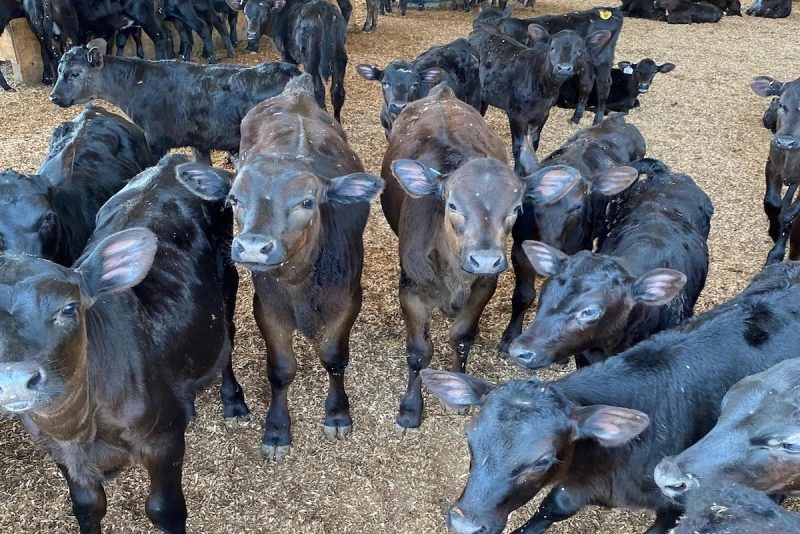
Beef-on-dairy calves are no longer just a trend; they’re a business strategy for producers aiming to squeeze more value out of every breeding decision. For dairy farmers, they offer a way to turn lower-producing cows into a new revenue stream. For feedlots, they promise improved feed efficiency and more desirable carcasses.
“Dairy producers are breeding lower milk production cows to beef sires to increase calf revenue,” says Melanie Concepcion, a Ph.D. student at Michigan State University, who recently presented on the economics of beef-on-dairy animals. “The idea is to add more value to existing Holstein calves by improving muscling, hide quality and market desirability.”
According to CattleFax, beef-on-dairy crosses started showing up in the fed slaughter mix around 2019. Today, they represent an estimated 2 million to 3 million head annually, contributing roughly 15% to 20% of total U.S. beef production and signaling a major shift in how dairy genetics can serve the beef supply chain.
“They’re here to stay,” Concepcion adds. “And the number of beef-on-dairy cattle is only expected to grow.”
Study 1: Feedlot Gains and Carcass Traits
To measure how these crossbreds stack up, Concepcion launched a study evaluating 75 Holstein and 75 beef-on-Holstein steers from Michigan calf raisers. Raised under identical conditions, the steers transitioned from starter to finishing diets and the performance differences were not surprising.
Beef-on-dairy steers:
- Reached market weight 21 days faster
- Converted feed more efficiently
- Posted a 20% larger ribeye area
- Scored lower yield grades, signaling better muscling
“They’re more feed efficient and have a greater ribeye area and fat thickness than the Holsteins,” Concepcion explains. “Their yield grade is also lower, which is a good thing because it means more yield and muscling.”
However, liver health raises red flags. Concepcion finds that 39% of the beef-on-Holstein steers develop liver abscesses, some severe enough to adhere the liver to the carcass.
“In those cases, you see trimming losses,” she says. “And that hurts overall carcass value.”
Premiums and Pitfalls: Are Crossbreds Priced Right?
Economically, the study shows that beef-on-dairy calves bring greater value but also come with a price tag that’s tough to justify.
“We pay $310 more per calf for the beef-on-Holsteins, but our data shows we should have only paid $273 more,” Concepcion says. “Yes, they should be worth more, but not as much as we paid.”
With some day-old beef on dairy crossbreds fetching upward of $1,000, Concepcion says the numbers simply don’t justify the premium in many cases.
“These calves clearly have more value than Holsteins, but not to the degree that some buyers are currently paying,” she says. “We’re still seeing inflated calf prices that don’t reflect actual feedlot performance or carcass returns.”
Study 2: Corn Silage and Liver Health
Looking to address liver concerns, Concepcion led a second study focusing on dietary fiber. The hypothesis: increasing corn silage in the finishing ration could help reduce liver abscess incidence by supporting better rumen health.
The study included 65 Holstein and 65 beef-on-Holstein steers. Each breed was fed a finishing diet with either 20% or 40% corn silage.
“We wanted to see if increasing fiber through higher corn silage inclusion reduces abscess rates,” she says.
The findings were clear:
- Steers on the 40% corn silage diet had significantly fewer liver abscesses
- The diet change did not affect feed efficiency or cost of gain
- Beef-on-dairy steers continued to outperform Holsteins in carcass traits, regardless of diet
“Increasing corn silage inclusion effectively reduces the amount of liver abscesses in cattle, regardless of breed,” Concepcion says.
Carcass Performance Remains Strong
Even with the shift in diet, beef-on-Holstein steers continue to demonstrate a clear advantage in carcass traits and processing yield compared to purebred dairy steers. These crossbreds exhibit:
- Higher hot carcass weights
- Greater dressing percentages
- Larger ribeye areas
- Lower kidney, pelvic and heart (KPH) fat
“Adding beef genetics to Holsteins results in more muscling,” Concepcion notes. “And that leads to higher carcass value.”
Interestingly, marbling and quality grade remain similar between breeds and diets. Most cattle grade in the low to mid-choice range, offering acceptable quality without excessive feed costs. Additionally, the lower KPH fat and higher dressing percentages give processors more saleable product, further boosting the overall economic benefit.
“Even with differences in feed and frame size, beef-on-dairy cattle continue to show consistency in carcass composition,” she adds. “This predictability is valuable for both feeders and packers.”
Feedlot Advantages Might Not Justify Current Calf Prices
Despite the performance benefits, the pricing issue resurfaces. In the second trial, beef-on-Holstein calves cost Concepcion $353 more than Holsteins, but break-even data shows they should only cost $281 more.
“We overpaid again, just like last time,” Concepcion says. “These studies show us that beef-on-dairy calves should be priced at a premium, but not as high as the current market suggests.”
Feed costs were actually lower for beef-on-dairy steers, thanks to shorter days on feed. And while the 40% corn silage diet increased feed cost slightly, it didn’t impact the cost of gain, making it a viable strategy for improving liver health without compromising efficiency.
Looking Ahead
While beef-on-dairy calves offer clear advantages in feedlot performance and carcass quality, Concepcion notes the market still needs tools to match pricing with actual value.
She continues to explore what drives health, gain and grading in these crossbreds, and her latest work includes studies on gut and liver health as well as comparisons across breed types like Simmental-Angus, Holstein and beef steers.
“The more we understand how these cattle grow, grade and ultimately eat, the better we can manage and market them,” she adds.
Your Next Read: How to Keep Good Hay From Going Bad: Barn Storage Tips That Protect its Quality and Value
To watch Cocepcion’s full webinar, click here:


