
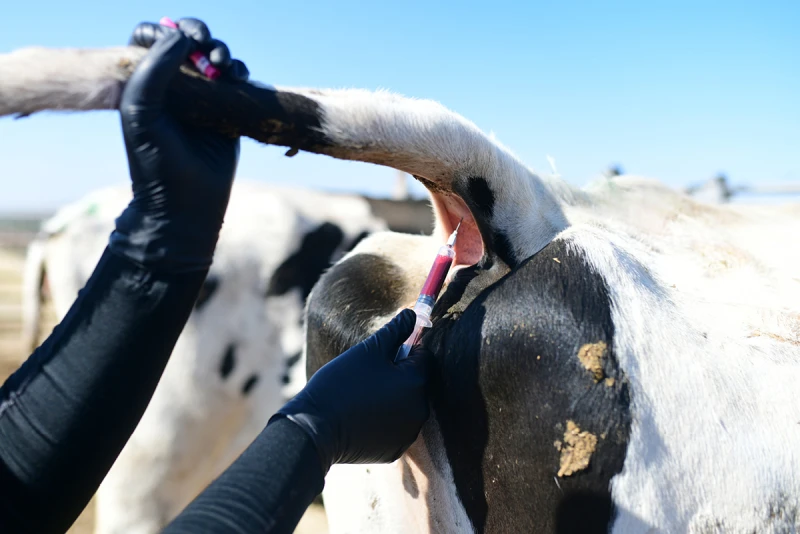
Johne’s disease has a diagnostic problem that has persisted for decades: infected cattle can harbor Mycobacterium avium subspecies paratuberculosis (MAP) for years while showing few or no clinical signs, and conventional tests may miss animals during that period. Now, researchers at the Australian Centre for Disease Preparedness have developed a blood-based diagnostic that uses a combination of host microRNAs and machine learning to identify cattle infected with MAP.
The study identified a three-microRNA signature that demonstrated an estimated diagnostic sensitivity of 92.8% and specificity of 94.8%. By comparison, the combined reference tests used in the study had estimated sensitivity of 75.5% and specificity of 96.0%.
Looking for the Cow’s Response to MAP
Current ante-mortem Johne’s disease diagnostics primarily rely on detecting MAP shedding through fecal culture or PCR, or detecting an antibody response through ELISA. Those signals can be limited during early infection, creating opportunities for infected animals to test negative.
Instead of looking directly for the pathogen, this research looked for changes in the cow’s circulating microRNAs, small RNA molecules involved in regulating gene expression.
Serum samples from MAP-infected and MAP-uninfected cattle in Australia and New Zealand were analyzed using RNA sequencing. The researchers identified 171 differentially expressed miRNAs, providing a large pool of potential biomarkers.
Machine-learning algorithms were then used to identify combinations of miRNAs that best distinguished infected from uninfected cattle.
The strongest model developed from the RNA-sequencing data used three miRNAs: miR-126-5p, miR-23b-3p and miR-497. When the researchers moved to a quantitative reverse-transcription PCR (RT-qPCR) assay designed for practical diagnostic use, a different three-miRNA combination performed best: miR-122, miR-125a and miR-194.
Three miRNAs Showed Strong Diagnostic Performance
The test correctly identified all 81 uninfected cattle and 15 of 17 infected cattle, achieving 98% accuracy and an overall diagnostic performance score of 0.97. Adding more miRNAs did not improve performance: the three-miRNA panel performed as well as or better than versions containing four or five markers.
The researchers also examined whether the signature was simply distinguishing dairy cattle from beef cattle, since the MAP-negative animals came from an Angus beef herd while most MAP-positive animals came from dairy herds. Clustering analysis showed stronger separation based on MAP infection than animal type, providing support that the signature was associated with infection rather than production system alone.
The assay showed additional promise when tested against cattle with bovine tuberculosis and several mastitis-associated pathogens. MAP-infected animals generally clustered separately from these groups, although the researchers note that much broader testing against other inflammatory and metabolic conditions is still needed.
Early Detection Remains the Big Question
Despite the promising diagnostic performance, the study does not yet demonstrate that the test can detect MAP during the earliest stages of infection.
The researchers primarily evaluated adult cattle, and they acknowledge that the current dataset cannot establish whether the miRNA signature appears during latent or early subclinical Johne’s. Further validation is needed in calves, heifers and cattle with early-stage infections.
The study also had a relatively small number of MAP-positive cattle and differences between the infected and uninfected cohorts in breed, herd and production system. Larger, more balanced and herd-matched studies will be needed before the diagnostic performance can be generalized to broader cattle populations.
Still, the approach represents a potentially important shift in Johne’s disease diagnostics. Rather than relying solely on MAP shedding or an established antibody response, the test uses a multimarker signature of the host response and machine learning to identify infection. The researchers have also moved beyond biomarker discovery toward a practical diagnostic, with the RT-qPCR assay showing good repeatability and consistent performance across four laboratories.
The next step may be the most important one: determining whether the miRNA signature can detect MAP before conventional tests do. Longitudinal studies following cattle from exposure through infection, particularly in calves, heifers and early-stage infections, will be needed to answer that question. If it can, the technology could provide veterinarians with a new tool for identifying infected cattle earlier in the course of Johne’s disease.


